The Contrapasso of the Violent Against God Nature and Art
The Divine One-act by Dante Alighieri · Digital Dante Edition with Commento Baroliniano · MMXIV-MMXX · Columbia University
Aristotle, Non-Christian Authority of a Christian Hell
- Dante postpones the explanation of the system of Hell until near one-tertiary of the way through Inferno
- in introducing the construction of his Hell, Dante offers a dramatization of the principle of deviation
- the treatment of violence offers an unsaid positive evaluation of material goods
- Dante-pilgrim asks Virgilio near the previous circles of Hell, those exterior the urban center of Dis; he uses a shorthand to summarize the mural they have traversed thus far, evoking each sin of upper Hell past its Dantean contrapasso
- these intratextual citations — the Inferno citing the Inferno — enhance the text's truth claims and the "reality" of Dante's Hell
- Dante's strong personal connection to Aristotle's works, which are carefully named: "la tua Etica" (your Ethics [Inf. 11 lxxx]) and "la tua Fisica" (your Physics [Inf.xi.101])
- the discussion "incontinenza" — lack of moderation or self-control — is presented in this canto for the only time: it is the technical Aristotelian analogue to the vernacular term "dismisura"
- the idea of incontinence implies a non-dualistic template for vice and virtue: for Aristotle vice partakes of the same impulse as virtue, but carries the impulse to an immoderate and excessive caste
- an exposition of the principle of mimesis, here Christianized
[1] Inferno 11 is not a dramatic canto. It can seem rather dry out, since information technology is devoted to outlining the structure of Dante's Hell. But Dante's apparently dry choices have juicy implications — in both the narrative/diegetic and the ideological/cultural domains.
[ii] Narratologically, this canto reveals a canny and interesting choice on Dante's part: he has delayed his exposition of the construction of Hell. Not until we are one-tertiary of the way through Inferno doesDante offer the states the organizational template of Hell. What are Dante'south reasons for postponing an explanation of the ideological basis of his Hell?
[three] Ideologically, the structure that is now revealed is profoundly counter-intuitive. Rather than basing his Hell on a Christian template, for instance a template based on the vii deadly sins, as we might have thought that Dante was doing in the early circles (we pass through animalism, gluttony, and avarice, in the order that conforms to the hierarchy of mortiferous vices), here we learn that Dante chooses to base the organizational template for his Hell on . . . a pagan philosophical text — Aristotle's Nicomachean Ethics.
[4] In fact, every bit I talk over in the Commento on Inferno 7, an attentive reader could accept already inferred that we have deviated from the template of the 7 vices when we reach the 4th circle, where instead of finding only avarice, as per the 7 vices, we find avarice paired with prodigality. The implications of including prodigality along with avarice in the 4th circumvolve are here fully unveiled: Dante'due south source for his Hell is Aristotle.
[5] No previous (or subsequent) Christian afterlife vision invokes a classical philosopher every bit its authority.
[half-dozen] In introducing the structure of his Hell, Dante offers a concentrated presence of the language of difference. Hither, as I note inThe Undivine Comedy, we find the language of più e menothat will boss much of Paradiso:
Inferno 11 [is] the canto that expounds divergence, clustering quantifiers in an try to give exact shape to the bureaucracy of hell: "tre cerchietti" (three picayune circles [17]), "primo cerchio" (kickoff circle [28]), "tre gironi" (three rings [30]), "lo giron primo" (the first ring [39]), "secondo /giron" (2nd ring [41-42]), "cerchio secondo" (2nd circumvolve [57]). Nosotros notice equally well an impressive spate of the adverbs first used in canto 5 to render difference, più and meno: since fraud "più spiace a Dio" (displeases God more [26]), the fraudulent are assailed by "più dolor" (more suffering [27]); since incontinence, on the other hand, "men Dio offende e men biasimo accatta" (offends God less and incurs less arraign [84]), God's vengeance is "men crucciata" (less wrathful [89]) in smiting such sinners. We find expressions that convey difference geographically, dividing those who are below and within from those who are to a higher place and without: while the fraudulent "stan di sotto" (are below [26]), the incontinent are non within the city of Dis, "dentro da la città roggia" (inside the flaming city [73]) only "sù di fuor" (up outside [87]). Nosotros find phrases like "di grado in grado" (from grade to course [18]) and "per various schiere" (in different groups [39]), and verbs that denote differentiation, such as distinguere and dipartire: the circle of violence "in tre gironi è distinto" (is divided into three rings [30]), and the incontinent are "dipartiti" (divided [89]) from the souls of lower hell. (The Undivine Comedy, p. 45)
[7] Virgilio's discourse in Inferno11 is theCommedia'due south first full-bodied discursive deed of differentiation, linguistically prefiguring the swell creation discourses of Paradiso.
[8] When Virgilio is annoyed at the pilgrim in verses 76-77, he essentially asks how Dante tin can have failed to grasp the principle that underlies all created existence: the principle of difference. The lexicon of differentiation that saturates Inferno 11 will be reprised, strangely but coherently, in Paradiso, the canticle that focuses on creation and created existence.
[9] The travelers take come up to the border of a steep cliff and, while acclimating the pilgrim'south olfactory organ to the stench that comes from beneath, Virgilio describes the structure of Hell. He makes an initial distinction betwixt sins of violence and sins of fraud ("o con forza o con frode" [either with force or with fraud Inf. xi.24]), indicating that fraud is more grievous and hence is the lowest of sins.
[10] Virgilio then outlines the sins of violence, which volition make upwards the seventh circumvolve, in Inferno xi.28-51. He divides the sins of violence into 3 categories: violence against God, violence against oneself, and violence confronting i'due south neighbor (Inf. eleven.31). He further indicates that each category can be inflected in 2 ways: as violence against persons and as violence confronting possessions (Inf. xi.32). The result is that the seventh circumvolve is subdivided into 3 rings, each of which houses two modalities of the same kind of violence:
VIOLENCE (Circle 7):
- Ring 1: Violence against others, 1) in their persons and 2) in their possessions (Canto 12)
- Ring ii: Violence against the self, 1) in 1's person and two) in i'due south possessions (Canto 13)
- Ring 3: Violence against God, 1) in His person and 2) in His possessions (Canti 14-17). A further complexity, to which I render below, is that for the purposes of this taxonomy God has two "possessions" (nature and art), and that therefore there are three kinds of violence confronting God, rather than ii.
[11] The showtime ii kinds of violence, violence against others and violence confronting the self, place a significant stress on possessions and fabric goods, very apparent in Dante's language: "in lor cose" (in their things [Inf. 11.32]), "nel suo avere" (in his possessions [35]), and "ne' suoi beni" (in his goods [41]). Both violence against others and violence against the cocky feature the abuse of fabric goods, which need to exist protected from trigger-happy depredation. Material goods, in other words, are hither viewed not as objects of disdain and reprehension, but rather as objects to be protected from human violence.
[12] Dante's taxonomy of violence thus harbors a positive evaluation of textile goods, implicit in the idea that fabric goods should be protected from violent depredation.
[13] Dante's taxonomy of violence is therefore another indication of the Aristotelian mode of Inferno xi, a manner that distances Dante from (for instance) a Franciscan approach toward material appurtenances, which we also find in the Commedia. As I discuss in the essay "Dante and Wealth, Between Aristotle and Cortesia" (cited in Coordinated Reading), extremely divergent perspectives on wealth and material possessions coexist in the Commedia.
[14] Commencement in Inferno 11.52, Virgilio deals with the sins of fraud, which he subdivides first into two large categories: 1) fraud practiced against those with whom one does not have a special bond of trust (Circle 8), and 2) fraud practiced against those with whom ane does have a special bond of trust — thus, expose (Circle ix). Virgilio and so outlines the 10 kinds of fraud that will exist institute in Circle eight and concludes by telling Dante that the traitors of Circumvolve 9 are located with Match (aka Satan or Dis, cf. "Dite" in Inf. 11.65), that is in the very lesser-nigh pit of Hell.
[15] We recollect that Virgilio had mentioned going to the very bottom of Hell in Inferno 9. At that time he explained to Dante that he was conjured past the sorceress Erichtho, who constrained him to go to the "cerchio di Giuda" (Judas' circle [Inf. nine.27]), described as "'fifty più basso loco eastward 'l più oscuro, / e 'fifty più lontan dal ciel che tutto gira" (the deepest and the darkest identify, / the farthest from the sky that girds all [Inf. 9.28-29]). Armed with new information, we now know that in going to the deepest circumvolve, farthest from heaven, Virgilio was going to the circumvolve that houses traitors. We learn likewise that Satan sits on this very point: "'l punto / de l'universo in su che Dite siede" (the point of the universe where Dis sits [Inf. xi.64-65]) and that the "cerchio minore" (smallest circle [Inf. 11.64]) holds the soul of Judas (the "Giuda" of "cerchio di Giuda"), who betrayed Jesus for thirty pieces of silver.
[16] The taxonomy of fraud is less complex than that of violence, since it does not avowal the subdivision that inflects violence as existence committed either against a person or against a possession. Simply fraud is massive: it embraces both Circle eight and Circle 9. There are 10 types of fraudulent sinners in Circle 8 solitary, packed into verses 58-60: "ipocresia, lusinghe e chi affattura, / falsità, ladroneccio east simonia, / ruffian, baratti e simile lordura" (hypocrisy and flattery, sorcerers, / and falsifiers, simony, and theft, / and barrators and panders and like trash [Inf. 11.58-60]).
[17] In narratological terms, fraud will occupy nearly one-one-half the real estate of Hell: the pilgrim enters the eighth circle in Inferno xviii and leaves the 9th circle when he leaves Hell in Inferno 34.
[18] Afterward learning about fraud, the pilgrim interjects a question. He wants to know why the sinners whom they have seen on their journey thus far are non within the metropolis of Dis: "perché non dentro da la città roggia / sono ei puniti, se Dio li ha in ira?" (why are they non all punished in the urban center / of flaming red if God is aroused with them? [Inf. 11.73-74]). Going back over the landscape of Hell that he and Virgilio have already traversed, Dante-poet at present formulates the pilgrim'south question using a special autograph.
[nineteen] The pilgrim summarizes the journey thus far past referring to each sin of upper Hell by its Dantean contrapasso:
Ma dimmi: quei de la palude pingue, che mena il vento, e che batte la pioggia, che southward'incontran con sì aspre lingue, perché non dentro da la città roggia sono ei puniti? (Inf. 11.lxx-74)
Simply tell me: those the dumbo marsh holds, or those driven earlier the wind, or those on whom rain falls, or those who clash with such harsh tongues, why are they not all punished in the metropolis of flaming red if God is angry with them?
[20] Dante has in this fashion accounted for all the circles of upper Hell with the exception of the get-go, Limbo. Similar the sixth circumvolve, heresy, Limbo is exclusively Christian and is not referenced in the Aristotelian accounting of Inferno 11.
[21] The below breakdown of verses lxx-72 isolates the periphrases that Dante deploys for each circle of upper Hell. These periphrases are distilled from his text's invented infernal torments, here condensed into pithy private taglines. We run across that verses 70-72 of Inferno 11 recapitulate circles 2-5 of Hell, albeit not in that guild.
[22] Here are Dante'south periphrases for each circumvolve, in the guild in which the author presents them in these verses:
- Verse 70: "quei de la palude pingue" (those whom the d ense marsh holds): a reference to Styx and therefore to the accidiosi and the wrathful = CIRCLE 5
- Poetry 71: "che mena il vento" (those whom the wind drives): a reference to the lustful = Circumvolve 2
- Verse 71: "due east che batte la pioggia" (those whom the rain beats): a reference to the gluttonous = CIRCLE three
- Verse 72: "due east che s'incontran con sì aspre lingue" (and who clash with such harsh tongues): a reference to the misers and the prodigals = CIRCLE 4
[23] These intratextual citations — the Inferno citing the Inferno — are a technique of verisimilitude. These citations treat the textual account as "real" and thereby raise the text's truth claims and the "reality" of Dante'due south Hell.
[24] Omitting reference to Limbo and to heresy, neither of which can be accommodated within an Aristotelian upstanding template, Virgilio answers Dante'due south question (why are the sins listed higher up not included within the city of Dis), by telling him to read his Ethics: "la tua Etica" (your Ethics [Inf. 11.80]). "Recall your Ideals" is Virgilio's way of telling Dante to remember Aristotle'due south Nicomachean Ethics, where Aristotle presents and discusses his concept of vice that is rooted in backlog desire.
[25] This is the lack of moderation that Aristotle calls "incontinence". It turns out that the sins of upper Hell, those not enclosed by the city of Dis, are sins of incontinence. They are sins of excessive and immoderate desire: want not moderated past virtue.
[26] Dante here uses, for the just time in theCommedia, the technical Aristotelian label "incontinence" (the Latin translation of the Greek akrasia): we find the word "incontinenza" in Inferno 11.82 and 83. In the Commento on Inferno 7 I discussed the vernacular terms misura and dismisura, analogues of the Aristotelian continenza and incontinenza. As I noted in the commentary on Inferno 7, the use of the Aristotelian term has significant implications that are comparatively appreciated by Dante criticism, which tends to lapse into dualistic structures that pit vice versus virtue. In such a scheme, want is easily viewed as negative, as a conduit to vice. But the Aristotelian model of incontinence is not dualistic: information technology places virtue at the mid-point between extremes of vice.
[27] In the Aristotelian model, vice partakes of the same impulse as virtue, merely carries the impulse to an immoderate and excessive degree. For Aristotle, cruel behavior is distinguished from virtuous behavior by the incontinent degree to which the impulse is pursued, not by demonizing the impulse itself. In this context we can better sympathise that for Dante "desire is spiritual move": "disire / ch'è moto spiritale" (Purg. eighteen.31-32). Want is an impulse that is not itself vicious in itself just is indeed essential to spiritual life.
[28] In the final section of Infernoxi Dante returns to the third kind of violence, violence against God, and to the implications built into the thought of "violence against God in His possessions". For the purposes of this taxonomy God has two "possessions": one) His "daughter", nature, and ii) nature's daughter, God'south "grand-girl", namely human art. The give-and-take "arte" in poetry 103 is to exist construed every bit all human being techne — thus art in its broadest sense, including all homo work, skills, crafts, and endeavors. Violence against nature is sodomy, while violence against human art is usury.
[29] In verses 97-105, Dante explains the principle of mimesis (Greek) or imitatio (Latin). The offset tenet is that nature "takes its course" from God. In other words, nature follows God: "natura lo suo corso prende / dal divino 'ntelletto eastward da sua arte" (nature takes her course from / the Divine Intellect and Divine Fine art [Inf. 11.99-100]). The second tenet is that, similarly, our human being art follows nature:
50'arte vostra quella, quanto pote, segue, come '50 maestro fa 'l discente; ì che vostr'arte a Dio quasi è nepote. (Inf. 11.103-five)
Your art follows nature, when it can just as a pupil imitates his master; so that your fine art is virtually God's grandchild.
[30] Dante expresses this principle more fully through a simile: he adds in verse 104 that our fine art follows nature in the way that a educatee follows a teacher. And, finally, the poet gives the principle of mimesis a genealogical twist, saying that our art is thus "about God's grandchild": "vostr'arte a Dio quasi è nepote" (Inf. xi.105).
[31] Dante has synthetic a genealogy — nature is God's kid and human art is God's grandchild — that is too a theory of fine art: we note the transition from the Divine Art in verse 100 to human fine art in verse 103. As such, it is a theory of realism that is essential for agreement Dante's view of his own fine art. He is a poet who heroically strives to imitate nature/reality to the all-time of his ability, "sì che dal fatto il dir non sia diverso" (so that my word non differ from the fact [Inf. 32.12]).
[32] We run across here a Christianizing of the Aristotelian concept of mimesis, whereby art imitates nature. Dante had already alluded to this doctrine in a Christian context in his linguistic treatise De vulgari eloquentia, where he presents the edifice of the Tower of Boom-boom by the biblical king Nembrot equally an act of hubris. Nembrot's airs involved trying "to surpass with his art non only nature, but also nature'southward maker, who is God":
Presumpsit ergo in corde suo incurabilis homo, sub persuasione gigantis Nembroth, arte sua non solum superare naturam, sed etiam ipsum naturantem, qui Deus est. (De vulgari eloquentia one.7.4)
So uncurable homo, persuaded by the giant Nembrot, presumed in his middle to surpass with his fine art not merely nature, merely also nature's maker, who is God.
[33] In linking "art", "nature", and "nature's maker, who is God", De vulgari eloquentia finer expounds the same doctrine subsequently presented in Inferno xi.
[34] Dante'due south grasp of the concept of mimesis does not come from Aristotle'due south Poetics, a work that was non yet bachelor in the West, just from Aristotle's Physics. From Physics 2.2.194a, the scholastics extracted the idea that was distilled in medieval anthologies as follows: "ars imitatur naturam in quantum potest" — literally, art imitates nature as much as it can.
[35] When the pilgrim wants to understand better how usury tin can exist construed as a course of violence against God, Virgilio therefore tells him to read Aristotle's Physics, sending him to notwithstanding another Aristotelian text: "la tua Fisica" (your Physics [Inf. 11.101]). Moreover, Virgilio — who manifestly has read and knows the Physicsvery well — specifies that Dante will observe the passage he needs afterward non too many pages: "non dopo molte card" (not many pages from the start [Inf. 11.103]). And, indeed, the passage cited in a higher place is in Book 2 of the Physics.
[36] As with "la tua Etica" in verse 80, Virgilio once more prefaces the philosopher's title with the pronoun "tua": your Ethics, your Physics.By attaching the pronoun "tua" commencement to Aristotle's Ethics and and so to his Physics, Dante indicates the profound personal connexion — melancholia and intellective — that binds him to the groovy philosopher's thought.
[37] At the very end of Infernoxi Virgilio glosses the concept of usury farther by invoking Genesis:
Da queste due, se tu ti rechi a mente lo Genesì dal principio, convene prender sua vita due east avanzar la gente; due east perché l'usuriere altra via tene, per sé natura eastward per la sua seguace dispregia, poi ch'in altro pon la spene. (Inf. eleven.106-11)
From these two, art and nature, it is fitting, if you recall how Genesis begins, for men to brand their way, to gain their living; and since the usurer prefers another pathway, he scorns both nature in herself and art, her follower; his hope is elsewhere.
[38] Nosotros see that Dante explicitly evokes "lo Genesì dal principio" (the kickoff of Genesis) in verse 107. Moreover, in the above verses, Dante effectively uses Aristotle's categories of nature and art, as derived from the Physics, in society to gloss Genesis. He refers to "queste due" (these 2 [106]), meaning nature and art, and then reaches the determination that the usurer "scorns both nature in herself and art, her follower": "per sé natura e per la sua seguace / dispregia" (Inf. 11.110-eleven).
[39] The final section of Inferno 11 thus effectively brings together Aristotle and the Bible: in verse 101 we find a reference to the Physics and in poesy 107 a reference to Genesis. The passage also offers a reading of Genesis in the lite of Aristotle.
[twoscore] The convergence of Aristotle with Genesis at the terminate of Inferno 11 is an extraordinary attestation to the Commedia's richly multicultural program, classical and biblical, hither evidenced in Dante's unique treatment of the organizational structure of Hell.
Appendix
Outline of the Structure of Hell, as Presented in Inferno eleven
— Circle one: Limbo (Inferno 4): this not Aristotelian sin is non discussed in Inferno eleven
— Circles ii-five: Sins of Incontinence:
lust (Inferno 5), gluttony (Inferno six), forehandedness and prodigality (Inferno 7), tristitia and acrimony (end of Inferno 7, Inferno viii)
— Circle 6: Heresy (Inferno ten): as in the case of Limbo, this sin is non Aristotelian and is therefore non discussed in Inferno 11
— Circumvolve 7: Violence, subdivided as follows:
Violence against one's neighbor ( Inferno 12): i) in her or his person, e.g. murder; ii) in her or his possessions, e.g. robbery
Violence against oneself (Inferno 13): one) in one'southward person, e.g. suicide; 2) in one'due south possessions, e.g. squandering
Violence against God: 1) in God's person, e.g. blasphemy (Inferno fourteen); 2) in God'southward possessions: 2a) Violence against God's "girl", nature, eastward.thousand. sodomy (Inferno fifteen-xvi); 2b) Violence against God's "granddaughter", human being "fine art" (skill, endeavour), eastward.g. usury (Inferno 17)
— Circle eight: Fraud, practiced against those who have no reason to trust yous, cleaved down into 10 categories:
pimping and seduction (Inferno 18), flattery (Inferno 18), simony, corruption of the Church (Inferno 19), false prophesy (Inferno xx), graft/corruption of the state (Inferno 21-22), hypocrisy (Inferno 23), fraudulent thievery (Inferno 24-25), false counsel (Inferno 26-27), sowing of discord (Inferno 28), falsifiers of metals, persons, coins, and words (Inferno 29-30)
— Circle nine: Fraud, practiced against those who have reason to trust you, i.e. Expose, divided into 4 categories:
Betrayal of family (Inferno 32), of political party (Inferno 32-33), of guests (Inferno 33), and of benefactors (Inferno 34)
Coordinated Reading
The Undivine One-act (Princeton: Princeton University Printing, 1992), Chapter 2, "Infernal Incipits," pp. 45-47; "Medieval Multiculturalism and Dante'due south Theology of Hell," 2000, rpt. Dante and the Origins of Italian Literary Civilisation (New York: Fordham U. Press), pp. 102-24; "Aristotle's Mezzo, Courtly Misura, and Dante's Canzone Le dolci rime: Humanism, Ethics, and Social Anxiety," in Dante and the Greeks, ed. Jan Ziolkowski (Cambridge: Harvard Academy Press, 2014), pp. 163-79. "Dante and Wealth, Between Aristotle and Cortesia: From the Moral Canzoni Le dolci rime and Poscia ch'Amor to Inferno 6 and Vii", Medioevo letterario d'Italia 15 (2018): pp.33-47.
Recommended Citation
Barolini, Teodolinda. "Inferno 11: Aristotle, Non-Christian Authority of a Christian Hell." Commento Baroliniano, Digital Dante. New York, NY: Columbia Academy Libraries, 2018. https://digitaldante.columbia.edu/dante/divine-comedy/inferno/inferno-11/
<paragraph number>
Commento Table of Contents
1 In su 50'estremità d'united nations'alta ripa
2 che facevan gran pietre rotte in cerchio,
3 venimmo sopra più crudele stipa;
4 due east quivi, per l'orribile soperchio
v del puzzo che 'l profondo abisso gitta,
6 ci raccostammo, in dietro, advert united nations coperchio
7 d'un grand' avello, ov' io vidi una scritta
8 che dicea: 'Anastasio papa guardo,
ix lo qual trasse Fotin de la via dritta'.
10 «Lo nostro scender conviene esser tardo,
11 sì che due south'ausi united nations poco in prima il senso
12 al tristo fiato; e poi no i fia riguardo».
13 Così 'l maestro; e io «Alcun compenso»,
14 dissi lui, «trova che 'l tempo non passi
15 perduto». Ed elli: «Vedi ch'a ciò penso».
16 «Figliuol mio, dentro da cotesti sassi»,
17 cominciò poi a dir, «son tre cerchietti
eighteen di grado in grado, come que' che lassi.
19 Tutti son pien di spirti maladetti;
xx ma perché poi ti basti pur la vista,
21 intendi come e perché son costretti.
22 D'ogne malizia, ch'odio in cielo acquista,
23 ingiuria è 'l fine, ed ogne fin cotale
24 o con forza o con frode altrui contrista.
25 Ma perché frode è de 50'uom proprio male,
26 più spiace a Dio; e però stan di sotto
27 li frodolenti, e più dolor li assale.
28 Di vïolenti il primo cerchio è tutto;
29 ma perché si fa forza a tre persone,
xxx in tre gironi è distinto due east costrutto.
31 A Dio, a sé, al prossimo si pòne
32 far forza, dico in loro e in lor cose,
33 come udirai con aperta ragione.
34 Morte per forza e ferute dogliose
35 nel prossimo si danno, e nel suo avere
36 ruine, incendi east tollette dannose;
37 onde omicide eastward ciascun che mal fiere,
38 guastatori e predon, tutti tormenta
39 lo giron primo per various schiere.
40 Puote omo avere in sé man vïolenta
41 e ne' suoi beni; east però nel secondo
42 giron convien che sanza pro si penta
43 qualunque priva sé del vostro mondo,
44 biscazza e fonde la sua facultade,
45 due east piange là dov' esser de' giocondo.
46 Puossi far forza nella deïtade,
47 col cor negando due east bestemmiando quella,
48 e spregiando natura eastward sua bontade;
49 e però lo minor giron suggella
50 del segno suo e Soddoma e Caorsa
51 e chi, spregiando Dio col cor, favella.
52 La frode, ond' ogne coscïenza è morsa,
53 può l'omo usare in colui che 'northward lui fida
54 e in quel che fidanza non imborsa.
55 Questo modo di retro par ch'incida
56 pur lo vinco d'amor che fa natura;
57 onde nel cerchio secondo s'annida
58 ipocresia, lusinghe east chi affattura,
59 falsità, ladroneccio due east simonia,
sixty ruffian, baratti eastward simile lordura.
61 Per l'altro modo quell' amor s'oblia
62 che fa natura, east quel ch'è poi aggiunto,
63 di che la fede spezïal si cria;
64 onde nel cerchio minore, ov' è 'fifty punto
65 de fifty'universo in su che Dite siede,
66 qualunque trade in etterno è consunto».
67 E io: «Maestro, assai chiara procede
68 la tua ragione, e assai ben distingue
69 questo baràtro east 'fifty popol ch'e' possiede.
70 Ma dimmi: quei de la palude pingue,
71 che mena il vento, due east che batte la pioggia,
72 e che s'incontran con sì aspre lingue,
73 perché non dentro da la città roggia
74 sono ei puniti, se Dio li ha in ira?
75 eastward se non li ha, perché sono a tal foggia?».
76 Ed elli a me «Perché tanto delira»,
77 disse, «lo 'ngegno tuo da quel che sòle?
78 o ver la mente dove altrove mira?
79 Non ti rimembra di quelle parole
80 con le quai la tua Etica pertratta
81 le tre disposizion che 'fifty ciel non vole,
82 incontenenza, malizia e la matta
83 bestialitade? e come incontenenza
84 men Dio offende east men biasimo accatta?
85 Se tu riguardi ben questa sentenza,
86 e rechiti a la mente chi son quelli
87 che sù di fuor sostegnon penitenza,
88 tu vedrai ben perché da questi felli
89 sien dipartiti, e perché men crucciata
90 la divina vendetta li martelli».
91 «O sol che sani ogni vista turbata,
92 tu mi contenti sì quando tu solvi,
93 che, non men che saver, dubbiar m'aggrata.
94 Ancora in dietro un poco ti rivolvi»,
95 diss' io, «là pigeon di' ch'usura offende
96 la divina bontade, due east 'l groppo solvi».
97 «Filosofia», mi disse, «a chi la 'ntende,
98 nota, non pure in una sola parte,
99 come natura lo suo corso prende
100 dal divino 'ntelletto e da sua arte;
101 east se tu ben la tua Fisica note,
102 tu troverai, non dopo molte carte,
103 che l'arte vostra quella, quanto pote,
104 segue, come 'l maestro fa '50 discente;
105 sì che vostr' arte a Dio quasi è nepote.
106 Da queste due, se tu ti rechi a mente
107 lo Genesì dal principio, convene
108 prender sua vita e avanzar la gente;
109 east perché fifty'usuriere altra via tene,
110 per sé natura e per la sua seguace
111 dispregia, poi ch'in altro pon la spene.
112 Ma seguimi oramai, che 'l gir mi piace;
113 ché i Pesci guizzan su per fifty'orizzonta,
114 e 'fifty Carro tutto sovra '50 Coro giace,
115 east 'l balzo via là oltra si dismonta».
Along the upper rim of a high bank
formed by a ring of massive broken boulders,
we came above a oversupply more than cruelly pent.
And hither, because of the outrageous stench
thrown up in excess by that deep abyss,
nosotros drew back till we were behind the lid
of a slap-up tomb, on which I fabricated out this,
inscribed: "I hold Pope Anastasius,
enticed to go out the truthful path by Photinus."
"It would be improve to delay descent
so that our senses may grow somewhat used
to this foul stench; and then we can ignore information technology."
So said my master, and I answered him:
"Practice find some compensation, lest this time
be lost." And he: "You run across, I've thought of that."
"My son, inside this ring of broken rocks,"
he then began, "in that location are 3 smaller circles;
like those that you lot are leaving, they range down.
Those circles are all full of cursed spirits;
so that your seeing of them may suffice,
learn at present the how and why of their confinement.
Of every malice that earns hate in Heaven,
injustice is the finish; and each such end
by force or fraud brings harm to other men.
Withal, fraud is man'southward peculiar vice;
God finds it more than displeasing-and therefore,
the fraudulent are lower, suffering more.
The violent have all of the first circle;
but since one uses force against three persons,
that circle'due south congenital of three divided rings.
To God and to i's cocky and to one'due south neighbour—
I mean, to them or what is theirs—one can
exercise violence, as you lot shall now hear clearly.
Violent death and painful wounds may be
inflicted on one's neighbor; his possessions
may endure ruin, fire, and extortion;
thus, murderers and those who strike in malice,
as well every bit plunderers and robbers—these,
in separated ranks, the kickoff ring racks.
A human can set vehement hands confronting
himself or his belongings; so within
the 2d ring repents, though uselessly,
whoever would deny himself your world,
gambling away, wasting his patrimony,
and weeping where he should instead be happy.
One can exist trigger-happy against the Godhead,
i's eye denying and blaspheming Him
and scorning nature and the good in her;
and so, with its sign, the smallest ring has sealed
both Sodom and Cahors and all of those
who speak in passionate contempt of God.
At present fraud, that eats away at every conscience,
is practiced by a man against some other
who trusts in him, or one who has no trust.
This latter way seems just to cut off
the bail of love that nature forges; thus,
nestled within the second circumvolve are:
hypocrisy and flattery, sorcerers,
and falsifiers, simony, and theft,
and barrators and panders and similar trash.
But in the old fashion of fraud, non simply
the love that nature forges is forgotten,
but added love that builds a special trust;
thus, in the tightest circle, where at that place is
the universe'south centre, seat of Dis,
all traitors are consumed eternally."
"Chief, your reasoning is clear indeed,"
I said; "it has fabricated patently for me the nature
of this pit and the population in information technology.
Merely tell me: those the dense marsh holds, or those
driven before the current of air, or those on whom
rain falls, or those who clash with such harsh tongues,
why are they non all punished in the urban center
of flaming red if God is angry with them?
And if He's non, why and then are they tormented?"
And and so to me, "Why does your reason wander
so far from its accustomed course?" he said.
"Or of what other things are yous now thinking?
Have you lot forgotten, then, the words with which
your Ethics treats of those 3 dispositions
that strike at Heaven's will: incontinence
and malice and mad bestiality?
And how the fault that is the least condemned
and to the lowest degree offends God is incontinence?
If you consider carefully this judgment
and phone call to listen the souls of upper Hell,
who bear their penalties exterior this city,
you'll see why they have been set off from these
unrighteous ones, and why, when heaven'southward vengeance
hammers at them, it carries lesser anger."
"O sun that heals all sight that is perplexed,
when I ask you, your answer so contents
that doubting pleases me as much every bit knowing.
Go dorsum a little to that point," I said,
"where yous told me that usury offends
divine goodness; unravel now that knot."
"Philosophy, for 1 who understands,
points out, and non in simply ane place," he said,
"how nature follows—as she takes her form-
the Divine Intellect and Divine Fine art;
and if you read your Physics carefully,
not many pages from the start, you'll see
that when it can, your art would follow nature,
just as a pupil imitates his master;
so that your art is nigh God'southward grandchild.
From these two, art and nature, information technology is plumbing fixtures,
if y'all retrieve how Genesis begins,
for men to make their way, to gain their living;
and since the usurer prefers another
pathway, he scorns both nature in herself
and art, her follower; his promise is elsewhere.
But follow me, for it is time to move;
the Fishes glitter now on the horizon
all the Wain is spread out over Caurus;
but beyond, can one climb downward the cliff."
UPON the margin of a lofty banking concern
Which great rocks broken in a circle made,
We came upon a nonetheless more savage throng;
And there, past reason of the horrible
Excess of stench the deep completeness throws out,
We drew ourselves bated behind the cover
Of a neat tomb, whereon I saw a writing,
Which said: "Pope Anastasius I concord,
Whom out of the right way Photinus drew."
"Deadening it behoveth our descent to be,
And so that the sense exist outset a little used
To the sad smash, and then we shall not listen it."
The Master thus; and unto him I said,
"Some bounty find, that the time pass not
Idly;" and he: "Thou seest I think of that.
My son, upon the inside of these rocks,"
Began he then to say, "are three pocket-size circles,
From form to course, like those which thou art leaving
They all are full of spirits maledict;
But that hereafter sight lonely suffice thee,
Hear how and wherefore they are in constraint.
Of every malice that wins detest in Heaven,
Injury is the end; and all such end
Either by force or fraud afflicteth others.
But considering fraud is man'due south peculiar vice,
More than it displeases God; and so stand lowest
The fraudulent, and greater dole assails them.
All the outset circle of the Violent is;
Just since forcefulness may be used against iii persons,
In three rounds 'tis divided and constructed.
To God, to ourselves, and to our neighbor can we
Employ force; I say on them and on their things,
Every bit thou shalt hear with reason manifest.
A death by violence, and painful wounds,
Are to our neighbor given; and in his substance
Ruin, and arson, and injurious levies;
Whence homicides, and he who smites unjustly,
Marauders, and freebooters, the first circular
Tormenteth all in companies diverse.
Man may lay vehement easily upon himself
And his ain goods; and therefore in the second
Circular must perforce without avail repent
Whoever of your world deprives himself,
Who games, and dissipates his belongings,
And weepeth there, where he should jocund be.
Violence tin can be washed the Deity,
In heart denying and blaspheming Him,
And by disdaining Nature and her compensation.
And for this reason doth the smallest round
Seal with its signet Sodom and Cahors,
And who, disdaining God, speaks from the heart.
Fraud, wherewithal is every conscience stung,
A man may practise upon him who trusts,
And him who doth no conviction imburse.
This latter mode, it would appear, dissevers
Only the bond of love which Nature makes;
Wherefore within the second circle nestle
Hypocrisy, flattery, and who deals in magic,
Falsification, theft, and simony,
Panders, and barrators, and the like filth.
By the other way, forgotten is that love
Which Nature makes, and what is subsequently added,
From which there is a special religion engendered.
Hence in the smallest circle, where the point is
Of the Universe, upon which Dis is seated,
Whoe'er betrays for ever is consumed."
And I: "My Master, clear enough proceeds
Thy reasoning, and full well distinguishes
This cave and the people who possess it.
But tell me, those within the fat lagoon,
Whom the air current drives, and whom the rain doth crush,
And who meet with such biting tongues,
Wherefore are they inside of the crimson city
Not punished, if God has them in his wrath,
And if he has not, wherefore in such mode?"
And unto me he said: "Why wanders then
Thine intellect from that which it is wont ?
Or, sooth, thy mind where is it elsewhere looking ?
Hast thou no recollection of those words
With which thine Ethics thoroughly discusses
The dispositions three, that Heaven abides not,—
Incontinence, and Malice, and insane
Bestiality ? and how Incontinence
Less God offendeth, and less blame attracts?
If thou regardest this conclusion well,
And to thy mind recallest who they are
That up outside are undergoing penance,
Clearly wilt 1000 perceive why from these felons
They separated are, and why less wroth
Justice divine doth smite them with its hammer."
"O Sun, that healest all distempered vision,
Yard dost content me so, when one thousand resolvest,
That doubting pleases me no less than knowing !
Again a little astern turn thee," said I,
"At that place where k sayest that usury offends
Goodness divine, and disengage the knot."
"Philosophy," he said, "to him who heeds it,
Noteth, non only in 1 place alone,
After what mode Nature takes her class
From Intellect Divine, and from its art;
And if thy Physics carefully chiliad notest,
After not many pages shalt thou notice,
That this your art as far as possible
Follows, as the disciple doth the master;
So that your art is, as it were, God's grandchild.
From these two, if m bringest to thy mind
Genesis at the beginning, it behoves
Mankind to gain their life and to advance;
And since the usurer takes another way,
Nature herself and in her follower
Disdains he, for elsewhere he puts his hope.
Simply follow, at present, as I would fain go on,
For quivering are the Fishes on the horizon,
And the Wain wholly over Caurus lies,
And far beyond at that place we descend the crag."
Along the upper rim of a high bank
formed by a ring of massive broken boulders,
we came above a crowd more than cruelly pent.
And hither, because of the outrageous stench
thrown up in excess past that deep abyss,
we drew back till nosotros were behind the hat
of a keen tomb, on which I made out this,
inscribed: "I agree Pope Anastasius,
enticed to leave the truthful path by Photinus."
"It would exist better to delay descent
so that our senses may grow somewhat used
to this foul stench; and and then we tin can ignore it."
Then said my main, and I answered him:
"Do observe some bounty, lest this time
be lost." And he: "Yous see, I've idea of that."
"My son, within this band of broken rocks,"
he then began, "in that location are three smaller circles;
like those that you are leaving, they range down.
Those circles are all total of cursed spirits;
so that your seeing of them may suffice,
learn at present the how and why of their confinement.
Of every malice that earns hate in Heaven,
injustice is the terminate; and each such end
by force or fraud brings impairment to other men.
Nevertheless, fraud is human being's peculiar vice;
God finds information technology more displeasing-and therefore,
the fraudulent are lower, suffering more.
The violent take all of the starting time circle;
only since one uses force against three persons,
that circle'due south built of 3 divided rings.
To God and to 1'southward self and to 1's neighbor—
I mean, to them or what is theirs—ane can
do violence, every bit you shall now hear clearly.
Violent expiry and painful wounds may be
inflicted on one's neighbor; his possessions
may suffer ruin, fire, and extortion;
thus, murderers and those who strike in malice,
also every bit plunderers and robbers—these,
in separated ranks, the beginning band racks.
A man tin can fix violent hands against
himself or his belongings; so inside
the 2nd band repents, though uselessly,
whoever would deny himself your world,
gambling away, wasting his patrimony,
and weeping where he should instead be happy.
One tin be violent against the Godhead,
1's heart denying and blaspheming Him
and scorning nature and the good in her;
so, with its sign, the smallest ring has sealed
both Sodom and Cahors and all of those
who speak in passionate contempt of God.
Now fraud, that eats abroad at every conscience,
is practiced by a human being against another
who trusts in him, or one who has no trust.
This latter fashion seems only to cut off
the bond of beloved that nature forges; thus,
nestled within the 2d circle are:
hypocrisy and flattery, sorcerers,
and falsifiers, simony, and theft,
and barrators and panders and similar trash.
Merely in the old way of fraud, not but
the love that nature forges is forgotten,
but added love that builds a special trust;
thus, in the tightest circle, where there is
the universe's heart, seat of Dis,
all traitors are consumed eternally."
"Master, your reasoning is clear indeed,"
I said; "information technology has fabricated obviously for me the nature
of this pit and the population in it.
Simply tell me: those the dumbo marsh holds, or those
driven before the wind, or those on whom
pelting falls, or those who clash with such harsh tongues,
why are they not all punished in the urban center
of flaming red if God is angry with them?
And if He'southward not, why then are they tormented?"
And then to me, "Why does your reason wander
so far from its accustomed course?" he said.
"Or of what other things are you lot now thinking?
Have you forgotten, then, the words with which
your Ethics treats of those iii dispositions
that strike at Heaven'southward will: incontinence
and malice and mad animality?
And how the fault that is the to the lowest degree condemned
and least offends God is incontinence?
If you consider carefully this judgment
and call to heed the souls of upper Hell,
who conduct their penalties outside this city,
y'all'll see why they have been gear up off from these
unrighteous ones, and why, when heaven's vengeance
hammers at them, information technology carries lesser anger."
"O dominicus that heals all sight that is perplexed,
when I ask yous, your answer so contents
that doubting pleases me as much equally knowing.
Go back a footling to that point," I said,
"where you told me that usury offends
divine goodness; unravel now that knot."
"Philosophy, for one who understands,
points out, and not in but one place," he said,
"how nature follows—as she takes her course-
the Divine Intellect and Divine Art;
and if you read your Physics carefully,
not many pages from the outset, you'll run into
that when it can, your art would follow nature,
just as a pupil imitates his master;
so that your art is almost God'south grandchild.
From these two, fine art and nature, it is plumbing fixtures,
if you call back how Genesis begins,
for men to make their style, to gain their living;
and since the usurer prefers another
pathway, he scorns both nature in herself
and art, her follower; his hope is elsewhere.
Only follow me, for information technology is time to move;
the Fishes glitter now on the horizon
all the Wain is spread out over Caurus;
only beyond, can ane climb down the cliff."
UPON the margin of a lofty bank
Which great rocks broken in a circle made,
We came upon a still more cruel throng;
And at that place, by reason of the horrible
Excess of stench the deep abyss throws out,
We drew ourselves aside backside the embrace
Of a slap-up tomb, whereon I saw a writing,
Which said: "Pope Anastasius I hold,
Whom out of the right way Photinus drew."
"Ho-hum it behoveth our descent to exist,
So that the sense exist outset a trivial used
To the deplorable blast, and so we shall not mind it."
The Master thus; and unto him I said,
"Some compensation find, that the time pass not
Idly;" and he: "Thou seest I call back of that.
My son, upon the inside of these rocks,"
Began he then to say, "are three modest circles,
From grade to class, like those which one thousand art leaving
They all are full of spirits maledict;
Just that hereafter sight alone suffice thee,
Hear how and wherefore they are in constraint.
Of every malice that wins hate in Heaven,
Injury is the end; and all such end
Either past force or fraud afflicteth others.
Only because fraud is human's peculiar vice,
More information technology displeases God; and and then stand everyman
The fraudulent, and greater dole assails them.
All the first circle of the Violent is;
Simply since force may be used confronting iii persons,
In three rounds 'tis divided and constructed.
To God, to ourselves, and to our neighbour can we
Apply force; I say on them and on their things,
Equally thousand shalt hear with reason manifest.
A death past violence, and painful wounds,
Are to our neighbour given; and in his substance
Ruin, and arson, and injurious levies;
Whence homicides, and he who smites unjustly,
Marauders, and freebooters, the outset round
Tormenteth all in companies diverse.
Human may lay tearing hands upon himself
And his own goods; and therefore in the second
Round must perforce without avail apologize
Whoever of your globe deprives himself,
Who games, and dissipates his property,
And weepeth at that place, where he should jocund be.
Violence can be done the Deity,
In heart denying and blaspheming Him,
And by disdaining Nature and her bounty.
And for this reason doth the smallest circular
Seal with its signet Sodom and Cahors,
And who, disdaining God, speaks from the heart.
Fraud, wherewithal is every censor stung,
A human may practice upon him who trusts,
And him who doth no confidence imburse.
This latter mode, information technology would appear, dissevers
Only the bond of dearest which Nature makes;
Wherefore within the second circle nestle
Hypocrisy, flattery, and who deals in magic,
Falsification, theft, and simony,
Panders, and barrators, and the like filth.
By the other mode, forgotten is that love
Which Nature makes, and what is after added,
From which there is a special faith engendered.
Hence in the smallest circumvolve, where the betoken is
Of the Universe, upon which Dis is seated,
Whoe'er betrays for ever is consumed."
And I: "My Primary, articulate enough gain
Thy reasoning, and full well distinguishes
This cave and the people who possess information technology.
But tell me, those within the fat lagoon,
Whom the air current drives, and whom the rain doth beat,
And who encounter with such bitter tongues,
Wherefore are they inside of the red urban center
Not punished, if God has them in his wrath,
And if he has non, wherefore in such way?"
And unto me he said: "Why wanders and so
Thine intellect from that which information technology is wont ?
Or, sooth, thy heed where is it elsewhere looking ?
Hast one thousand no recollection of those words
With which thine Ethics thoroughly discusses
The dispositions three, that Heaven abides not,—
Incontinence, and Malice, and insane
Bestiality ? and how Incontinence
Less God offendeth, and less arraign attracts?
If k regardest this determination well,
And to thy listen recallest who they are
That up exterior are undergoing penance,
Conspicuously wilt chiliad perceive why from these felons
They separated are, and why less wroth
Justice divine doth smite them with its hammer."
"O Dominicus, that healest all distempered vision,
Thou dost content me so, when yard resolvest,
That doubting pleases me no less than knowing !
Once more a niggling backward turn thee," said I,
"There where thou sayest that usury offends
Goodness divine, and undo the knot."
"Philosophy," he said, "to him who heeds it,
Noteth, not only in one identify alone,
Later what fashion Nature takes her form
From Intellect Divine, and from its fine art;
And if thy Physics carefully thou notest,
After not many pages shalt thou observe,
That this your art equally far as possible
Follows, as the disciple doth the principal;
And then that your art is, as it were, God's grandchild.
From these 2, if thou bringest to thy mind
Genesis at the beginning, it behoves
Flesh to gain their life and to advance;
And since the usurer takes another way,
Nature herself and in her follower
Disdains he, for elsewhere he puts his hope.
But follow, at present, equally I would fain become on,
For quivering are the Fishes on the horizon,
And the Wain wholly over Caurus lies,
And far beyond at that place nosotros descend the crag."
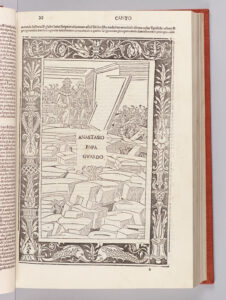
Every bit Dante and Virgilio leave the sixth circle and the latter explains the structure of Hell, Dante sees an inscription about Pope Anastasius (Inf. xi.8-nine).
Related video
View all lecture videos on the Dante Course page .
Reading by Francesco Bausi: Inferno eleven
For more readings by Francesco Bausi, come across the Bausi Readings page.
Source: https://digitaldante.columbia.edu/dante/divine-comedy/inferno/inferno-11/
0 Response to "The Contrapasso of the Violent Against God Nature and Art"
Post a Comment