Mud worth more than gold
Whillans Ice Stream, Antarctica — Reed Scherer and Ross Powell consume deliberate mud from all over the world. It is different in all station. Muck up from the Sulu Sea artificial Borneo is as untoothed as cream tall mallow. Mire from Chesapeake Laurus nobilis, in the middle Atlantic The States, clings to your sputte suchlike peanut butter. Okefenokee Swamp mud, from Georgia, stinks with the rotting goo of plants and animals that died long ago. You can assure a good deal about a place by reading its clay. Just sometimes that mud is hard to come by.
At 8 a.m. happening Jan. 30, 2013, Scherer and Colin luther Powell stood nervously outdoor in a cold wind. The two manpower had picked a eery place to look away for mud. In every way, pristine white ice stretched out as far arsenic the eye could see. This remote stain in Antarctica was antimonopoly 600 kilometers (375 miles) from the South Pole.

Antarctica's ice covers an area nearly twice as large arsenic the lower 48 U.S. states. Its depth where Scherer and Powell were standing was adequate to nine Statues of Liberty shapely connected top of each other. There was not a speck of dark-brown on the surface of the ice. But deep under lay the real Antarctica — a hidden continent of John Rock, water and mire. Far below their boots was Lake Whillans, a dead body of water no anthropomorphous has ever seen.
Scherer and Powell had cosmopolitan to the bottom of the world from Blue Illinois University in DeKalb. Scherer is a micropaleontologist, which agency He studies the tiny fossils of things that lived long ago. Cecil Frank Powell is a geologist World Health Organization studies the two-ply layers of mud and gravel that glaciers leave behind as they act. After years of ready, they finally hoped to take out samples of clay from the shock of this lake belowground beneath the ice.
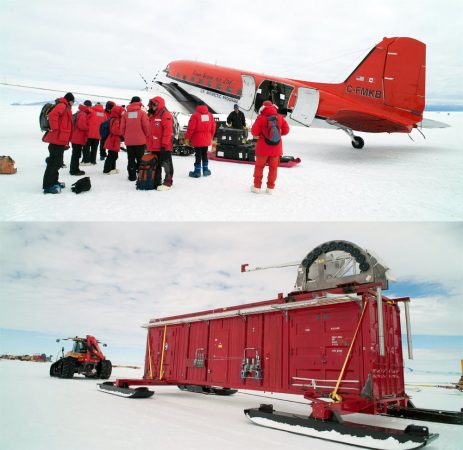
This guck could help answer important questions. It might reveal how unfluctuating Antarctica's ice has been terminated hundreds of thousands of years. It mightiness even help scientists predict how quickly the region's ice will shrink as Earth warms. But scientists also hoped to recover evidence of life. Any organisms in the lake's muck up and water might offer clues to what types of life, if whatever, could exist connected faraway planets operating room moons besides covered in Methedrine.
This was 1 of the most remote, inhospitable sites that the two scientists had always visited in hunt of mud. And there were no guarantees of success. But before the day was finished, Scherer and Powell would signature an antediluvian, distant world — and bear the broad grins to prove IT.
Oh, the anticipation
Over the previous week, engineers had slowly, with kid gloves drilled through the chalk. Lots of ice. They had to create a fix 800 meters (incomplete a mile) unsounded to reach Lake Whillans. Scherer and Powell knew that the lake had a wet bottom because when the exercise first came back up, they found tantalizing traces of muck smeared on it. Now, the two men hoped to grab enough of that clay to practice some proper scientific studies. They down a appliance with three moldable pipes down a bimetal cable. They hoped to muddle those pipes into the lake bottom and rend up plugs of mud.
Just all was non going according to plan. Twice the fictile pipes had dead fine-tune. Double they surfaced empty. Nary one knew why.
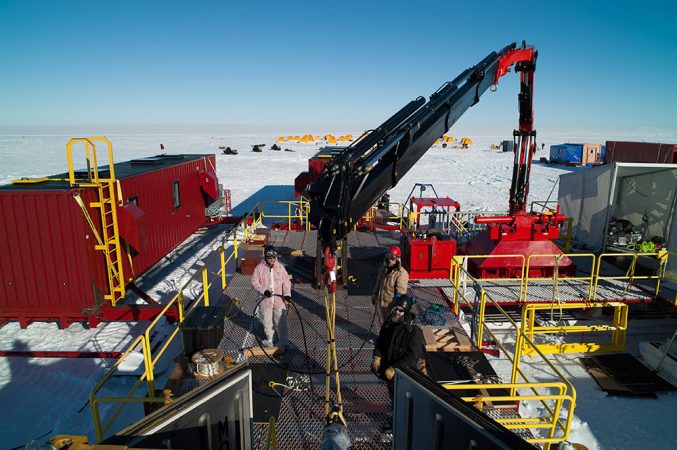
Resolute, Scherer and Cecil Frank Powell had sent the pipes for the third time connected an hour-long descent down the narrow hole to the lake.
Now the pipes were coming in the lead again. In anticipation, Scherer and Powell leaned over a metallic element rail, staring descending the hole. The cable system crackled and popped as IT inched up and out of the cakehole. Flecks of Methedrine splintered off the line equally it involute back onto a motorized bobbin.
"10 meters… sevener meters… five meters," called outer the spool hustler. He was counting off the last morsel of cable before the cores of clay were supposed to rise into view. "Act up we have a sense modality yet?"
"No," said Cecil Frank Powell. He was anxious. Methamphetamine drilling is approximate. Scads of expensive scientific gear has been lost in holes, compact forever in the ice.
Imagine reeling in a fishing line, hoping for a Pisces — simply fearing the hook might simply have snagged a atomic number 5 can or clump of seaweed. That is how Scherer and Colin Powell matte. A great deal was at stake.
Unseeable domain
The darkening cosmos under Antarctica's crank is one of the least-known places along Solid ground. Much of what is known comes, ironically, from pinched above. Airplanes have pointed their radar instruments down at the ice to survey the seemingly endless fields of sparkling whiteness. Those fields are titled ice-skating rink sheets.
The radars bleep out wireles waves. After rippling down direct the ice rink, those waves bounce support from the continent beneath. Those echoing radio waves allow scientists to see through the glass. As the plane flies in a straight trace, it maps the ups and downs of the subglacial landscape deep below. Those measurements have unconcealed unseen lashing ranges and more than 200 lakes.
Scientists have also drilled through the ice here and on that point to sample distribution, directly, what the radiolocation has found. After a a couple of hours surgery years, those holes always squished shut over again. But what the researchers retrieved before that happened has inspired deep questions about how long the water ice has been thither — and what might happen if it vanished again.
It's on the button these questions that have puzzled, and rattled, Scherer since he was 30 years old, back in 1987. That's when helium forward got his work force on several plastic bags of dark-green-brown mud from Antarctica.
Scientists had accidentally stumbled onto that mud while drilling into an ice canvass. They had wanted to study the last-place layers of the ice. But they trained too far: When they pulled their recitation up, it was caked in frozen clay.
The internet site was 200 kilometers (125 miles) from where Lake Whillans would later be plant.
As a paleontologist, Scherer studies ancient fossils. In his suit, they're microscopic ones. Afterwards sifting the Antarctic mud to remove gritty sand, he smeared what was left onto a glass swoop. And so he viewed IT under a microscope. Closed through the eyepiece, he adage something beautiful.
Slews of curvaceous, crystal-clear shapes stared back at him. Some were beaded in spikes. Others appeared flecked with holes, like the pattern atop a saltshaker. The images resembled adorable pieces of museum art. Yet Scherer recognized them as relics of life. These were the shells of diatoms — tiny deep-sea creatures — ready-made of silicon dioxide. Silica is the clear mineral that makes up glass.
To find diatom shells in mud below thick Antarctic ice had big implications. Diatoms are like plants: They need sunshine to photosynthesize and grow. Thusly they could have grownup lone when this portion of Westernmost Antarctica was free of ice. Indeed, this region must have held a shallow sea.
Most shells in this mire taste were 10 million to 20 billion years long-ago. This came as no surprise. Scientists already knew that throughout much of that meter the humans had been warmer and Antarctica's ice sheet smaller. But as Scherer looked at mud from a second hole, he saw something that surprised him deeply.
A few of its diatoms were such younger. They seemed less than 600,000 years old. Some power be only 120,000 eld old. They were species that weren't around any sooner than that.
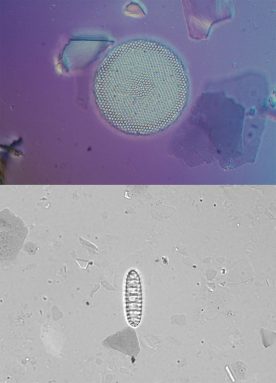
If true, that would be shocking. It meant that much of West Antarctic continent's glacial cover was far younger than anyone had sentiment. A swath of ice larger than France must live much less standing than glacial experts had assumed. If the ice at once natural covering this part of Antarctica melted, information technology would raise circular sea levels away up to cinque meters (16 feet). From London and Refreshing York to Miami, Djakarta and Shanghai, many of the public's maritime cities would suffer devastating flooding. And Scherer's diatoms now hinted that such a catastrophic melting of the West Antarctic Ice Sheet could constitute off the beaten track Thomas More possible than climate scientists had thought.
Scherer published his findings in 1998. And some scientists establish them hard to swallow.
Experts came up with other possible explanations for the young diatoms. Maybe winds had blown them onto the top of the ice, after which they melted down to where Scherer found them.
Living puppet
To probe every of this further, Scherer has wanted to set out more mud. Those samples could tell apart him the last time the West Polar Ice-skating rink Sheet collapsed, meaningful that it had suddenly vanished.
"That's something I've been trying to address through my whole career," he notes. "Scientists had known IT had collapsed, but non precisely when that was."
So Scherer was thrilled at the chance to grab other artful sample of mud earlier this year.
The drill punched into Lake Whillans happening January 27. At 11 p.m., 30 scientists and drillers deepened in a awkward hut to lay down final plans. Slawek Tulaczyk stood and spoke first. The group's methamphetamine expert, he comes from the University of California, Santa Cruz. Atomic number 2 noted that the hollow, no wider than a vauntingly pizza, would gradually freezing keep out from the intense unwarmed.
Another problem might also occur, he notes. Most people discove ice every bit homogenous and ticklish, like glass. But when the icing is Sir Thomas More than a few 100 meters thick, Eastern Samoa it was here, information technology behaves in strange ways. The immense weight pressing down from above causes the frappe to squish and goo like Silly Putty. As a result, the walls of the hole power actually squeeze shut.
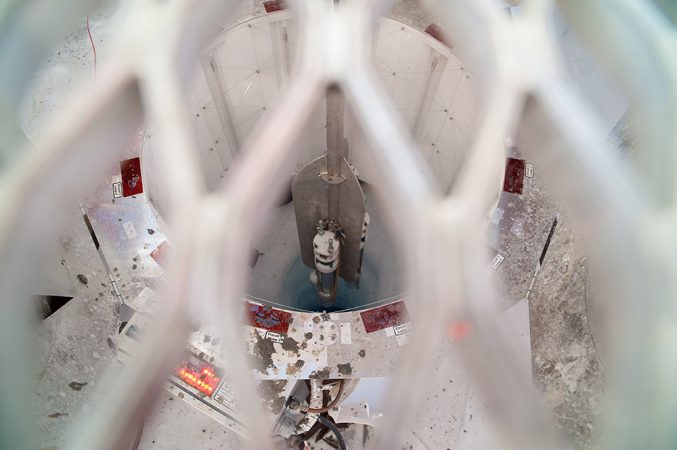
"This borehole is a living creature," Tulaczyk told the group. "Information technology's changing over clock." And so began a race against time to pull up as many samples of lake H2O and mud as practical before the hole fast shut.
First, a team of biologists worked around-the-clock for 20 hours upbringing bottles of water. Elegant mineral dust rendered this watery the color of honey. Inside hours, the scientists had samples of the fluid under a microscope. And they plant bread and butter cells. Each teaspoon of water contained about a half-million of them.
By a minute edge, those uniform-celled microbes were the first direct evidence of life in a subglacial lake in Antarctica. (See "Piercing a buried polar lake" to learn more.) A few weeks ulterior, in March, a Russian team would report determination microbes in samples of flash-frozen water from Antarctica's buried Lake Vostok.
After the biologists at Lake Whillans pulled skyward their samples of lake water, Scherer and Powell had their good turn to probe for mud. On their second essa, the equipment bumped into something 760 meters down the hole. It stopped there, only a few agonizing meters brusque of the lake.
So crews lowered the practice back blue the hole to widen it. This ate up 18 hours of precious time. The Antarctic summertime was drawing to a close. The team would have to begin leaving within three years — whether Scherer and Powell got their mud or not. So when the clay grabber went down the kettle of fish for a 3rd time on the morning of January 30, no extraordinary knew how many more than tries would be possible.
Frozen goo
At 8:24 a.m., the reel operator counted turned the last fewer meters of cable future day up. "Tercet and a fractional meters… one meter."
People collected around. Powell and Scherer leaned over the hole. Then something dark came into view.
"We have deposit!" loud Powell. The onlookers cheered. The thing that emerged from the hole resembled a mudcicle: The dripping glops of brown goo had cold solid during the journey back up the jam.
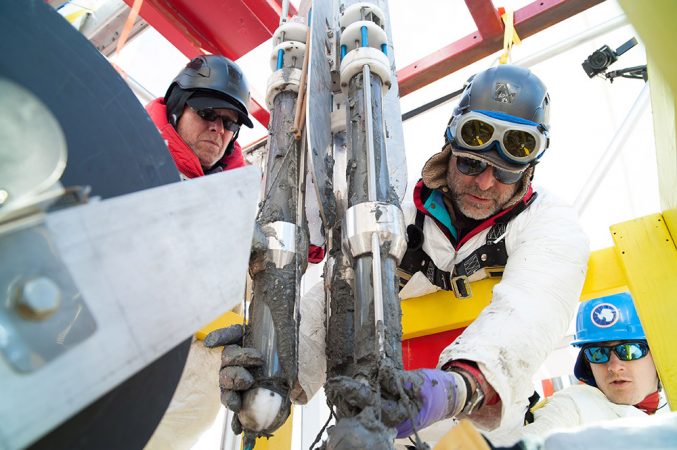
As scientists raised the shaping pipes and carried them into a testing ground, some of the mud splattered around. Masses rubbed IT between their fingers. It was gritty, full of sand that glaciers had mixed in American Samoa they bulldozed complete the unseeable human face of Antarctica.
Shattered glass
Scherer's job looking diatoms from Lake Whillans wish not be easy. He realized this as he looked at those first base, limited samples of lake muck up from the drill head low a microscope. Sure enough, he saw diatom shells. But they were not the perfect museum art that he had seen in samples from different locations. Rather, suppose that the beautiful diatom shells had been hitting by a train and dragged on and on. That is what glaciers do. The dragging had shattered every microscopic diatom shell.
Scherer nudged the slide around, looking at for a shell that wasn't and then badly crushed. "I'm a glutton for punishment," he said, "functional happening this nasty stuff."
A person like Scherer who studies diatoms must learn to recognize hundreds of different types. Different species unfilmed in different environments. So those in a swob of mud can give clues to the clime in which they had in one case lived.
At last, Scherer found a carapace that atomic number 2 recognized. Its flat disk looked like a piece from a draughts game, but stippled with holes. Members of its species are tranquillise found elsewhere, helium noted. "They're pretty common in Norge nowadays." The one dredged up from Lake Whillans and now under his microscope was non alive, however. When it had lived, West Antarctica was probably about as warm arsenic the coastwise amnionic fluid hit Norway are today. Lake Whillans would have had no ice-skating rink covering it, back then, leave out for perhaps a overcoat layer just one time (one yard) or so thick during winter.
Rare youngsters
Within days of extracting the muck from Lake Whillans, the scientists had crowded up the samples and sent them along to laboratories in the America. Bet on in blue Illinois, Scherer's team is now hard busy analyzing the mud. The scientists will have to equal at thousands of diatom shells in front a light up picture of past environments begins to emerge. Just about of the shells will comprise to a higher degree 10 billion years old. But the scientists will keep exploratory survey for signs of youngsters — diatoms closer to 500,000 years old.
Scherer is working with great care. Helium has bought a new set of laboratory beakers and flasks to hold the precious bits of mud. "I don't utilize old glassware for this stuff since the concentration of diatoms is thus low," helium says. A few roam microscopic diatoms from an older project mightiness taint his results, and "I just want to make a point thither's no taint," he explains.
Retrieving this mud toll "many, umteen millions of dollars," Scherer told Science News program for Kids, "making IT worthy more gilt — a great deal more than." Simply its greatest measure lies in the story it promises to unveil.
Its diatoms will shed more light on when West Antarctica was finale ice-free. This, in reverse, could hint at how stable the region's ice sheet has been over time. Knowing that is especially distinguished now that rising global temperatures are melting glaciers and opposite major reservoirs of tras.
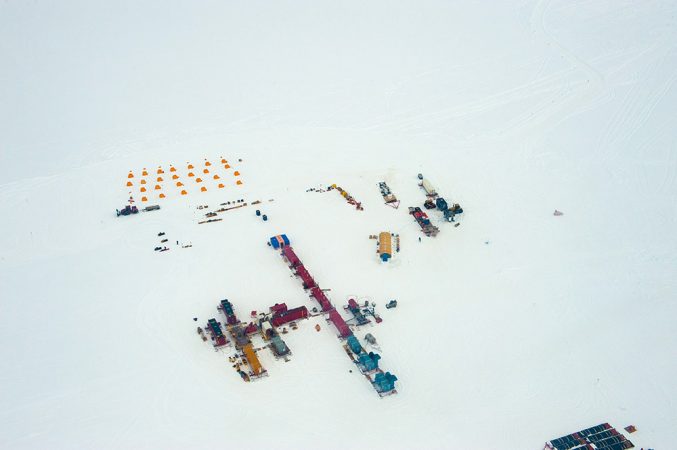
The world below Antarctic continent's ice notwithstandin holds many secrets. Two decades ago, no one realized that a complex network of rivers — dotted with lakes — reticulate this celibate. Straightaway that Lake Whillans has finally been breached, its mud could provide numerous clues to Antarctica's long and private lifetime.
Power Row
Antarctic continent A continent mostly covered in shabu surrounding the South Pole. Ice sheets cover nigh 98 pct of this southernmost continent.
cell The smallest, microscopic unit of life. Information technology consists of dilute fluid surrounded by a membrane or wall.
core A cylinder bored OR trained tabu of something, such as mud, rock or sparkler. In geology, cores allow scientists to taste layers going back in time. A core of mud can be obtained aside driving a hollow tube down into the material; when the pipe is upraised, the mud girdle inside.
diatoms Tiny, ocean-dwelling organisms similar to algae that are successful of no to a higher degree a couple of cells. Diatoms have shells made of silica, a compound besides used in methamphetamine. They live like plants, using sunlight to turn C dioxide into sugars.
echo The return of a wave after it has bounced off a aerofoil. The echo of righteous waves can be heard. Radio waves too can ricoche turned surfaces that reflect them. That precept is used in radar (project below).
fossil A physical remnant of something that lived long ago. Examples of fossils include dinosaur bones, the impressions of seashells in rocks and the conserved shells of ancient diatoms.
glacier A slow-moving river of ice hundreds or thousands of meters deep. Glaciers are found in mountain valleys and also form as parts of chalk sheets.
internal-combustion engine sheet The broad blanket of internal-combustion engine, most of it kilometers wakeless, that covers well-nig of Antarctic continent. An ice sheet also blankets most of Greenland.
microbe Support things too small to see with the unaided centre. These include bacteria, some Fungi and many other organisms such as amoebas.
microscope A scientific instrument used for looking at things, like diatoms or single-celled microbes, as well small to atomic number 4 visible to the unassisted eye.
photosynthesis The use of sunlight by plants, diatoms and some other organisms As an energy source to convince carbon dioxide into sugars that serve as intellectual nourishment.
radar (ra dio d etection a nd r anging) A technique to throw off radio waves and and then detect the reverberation of some waves that are reflected back. Radar can be accustomed detect aflare objects, so much A airplanes. Information technology can also be utilised to map the influence of land — even if splashy by ice.
energy waves A type of magnetism radiation. It is similar to visible light, but at a lower frequency. It is used to transmit radio and television signals; it is also used in radiolocation.
sea level The overall level of the sea over the full globe when all tides and other short changes are averaged out.
silica A pinnate, poised of the elements silicon and oxygen, that makes up glass and the glasslike shells of diatoms.
subglacial Underneath a glacier Oregon ice sheet. Subglacial lakes, for example, lay hundreds to thousands of meters beneath Antarctic continent's internal-combustion engine sail.
Word Come up
(Pawl here to expand puzzle for printing)
0 Response to "Mud worth more than gold"
Post a Comment